



Did You Know?
What “Hyperactive/Impulsive” Means
Hyperactive vs. Inattentive ADHD
Wondering if it’s ADHD?
Symptoms, Hyperactive/Impulsive ADHD
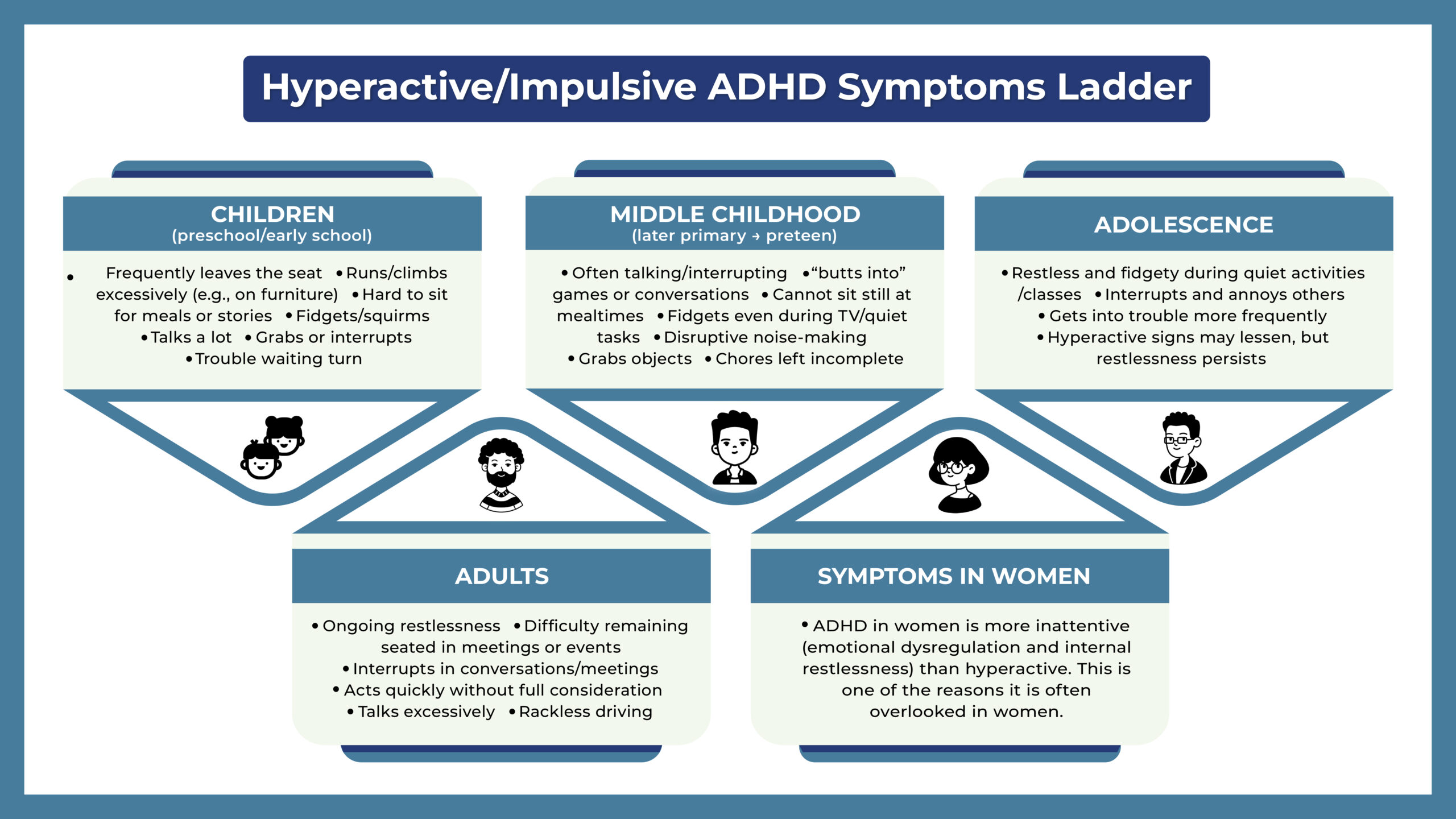
Symptoms Ladder
Children (preschool/early school)
- Frequently leaves the seat
- Runs/climbs excessively (e.g., on furniture)
- Hard to sit for meals or stories
- Fidgets/squirms
- Talks a lot
- Grabs or interrupts
- Trouble waiting turn
Middle childhood (later primary → preteen)
- Often talking/interrupting
- “butts into” games or conversations
- Cannot sit still at mealtimes
- Fidgets even during TV/quiet tasks
- Disruptive noise-making
- Grabs objects
- Chores left incomplete
Adolescence
- Restless and fidgety during quiet activities/classes
- Interrupts and annoys others
- Gets into trouble more frequently
- Hyperactive signs may lessen, but restlessness persists
- Ongoing restlessness
- Difficulty remaining seated in meetings or events
- Interrupts in conversations/meetings
- Acts quickly without full consideration
- Talks excessively
- Rackless driving
Symptoms in Women
Don’t Ignore Subtle ADHD Signs in Women
Do you often feel mentally restless, overwhelmed, or emotionally drained but can’t see a clear reason why? It might not be “just stress.” Many women live with undiagnosed ADHD for years before finding the right help. Early diagnosis is necessary, and AZZ can help clear this doubt.
What Causes Hyperactive-Impulsive ADHD?
The hyperactive-impulsive ADHD does not have a separate cause from its other types. As ADHD is a neurodevelopmental condition, it is strongly related to genetic contribution, with additional factors like early-life risk factors. There is not a single test that identifies the cause of ADHD.
What the Best Evidence Shows
- Genetics has a major role. If your parents or siblings have ADHD, you are at greater risk. Studies show that about 74% of the overall risk is due to genetics.
- A 2025 review of 55 studies (4.0 million people) found that smoking during pregnancy raises the risk of ADHD in children by 1.5×.
- Being born very preterm (before 32 weeks of pregnancy) or with very low birth weight also increases the risk of ADHD.
- Studies observed that lead (heavy metal) exposure significantly enhances the risk of ADHD.
- Significant head injury and alcohol use during pregnancy might be additional risk factors for ADHD, but they do not directly guarantee ADHD. During evaluation, clinicians screen for these signs and risks.
Testing & Diagnosis of ADHD, Hyperactive/Impulsive Type
You Don’t Have to Do This Alone
DSM-5 Criteria
- Symptoms should start before the age of 12.
- They should be present in more than one setting (e.g., home, school/work, with friends/relatives).
- The symptoms should clearly interfere with or reduce the quality of social, school, or work functioning.
- There should be no other medical condition responsible for the symptoms.
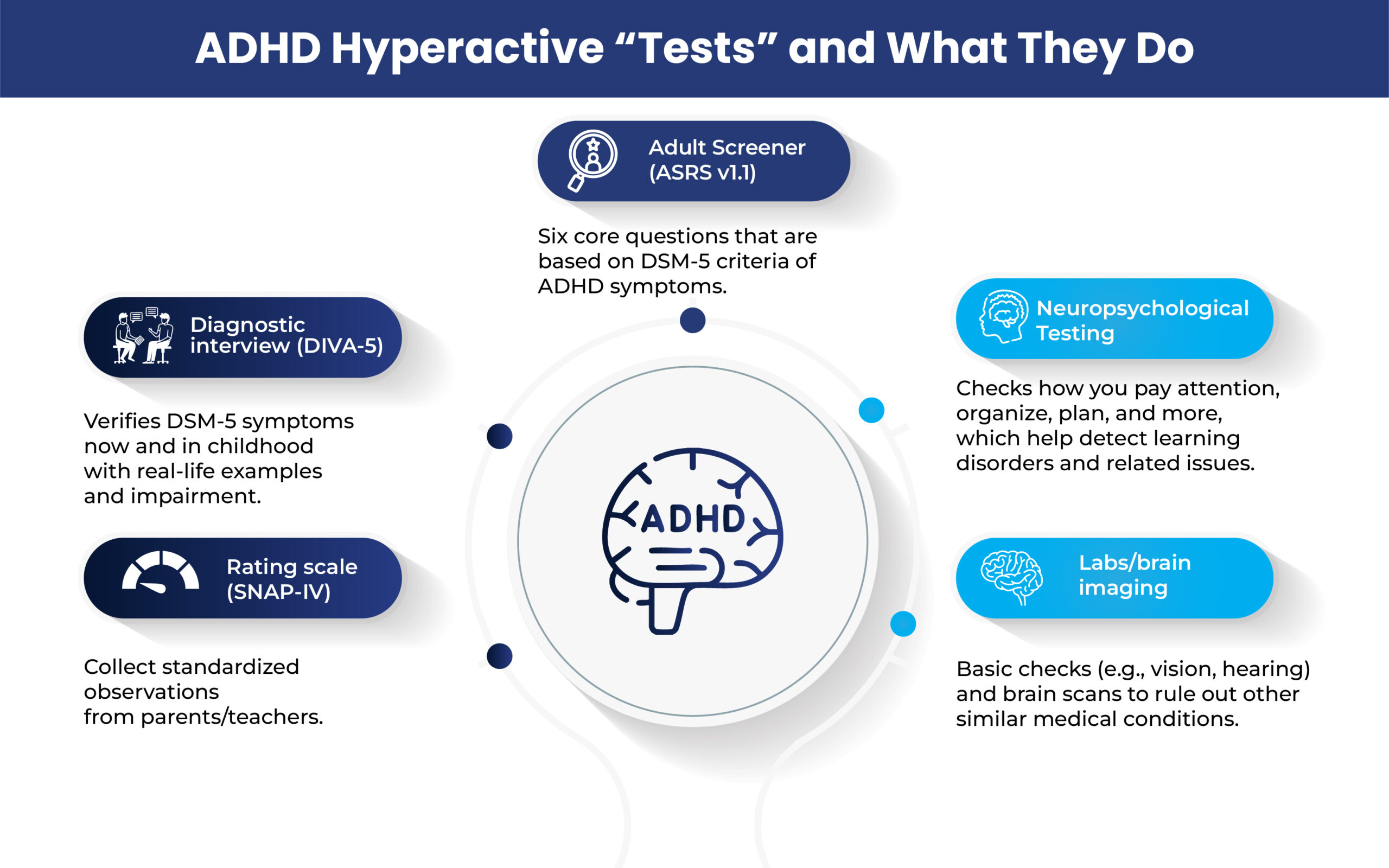
ADHD Hyperactive “Tests”—What They Can & Can’t Do
| Tool | What It Does | What It Doesn’t Do |
|---|---|---|
| Rating scales (Vanderbilt, Conners, SNAP-IV) | Measure ADHD symptoms like inattention and hyperactivity through teacher, parent, or self-reports. | Help with clinical assessment, and do not diagnose ADHD by themselves. |
| Adult Screener (ASRS v1.1, 6-item) | Screens adults for ADHD traits based on everyday attention and impulse patterns. | It cannot confirm ADHD, nor can it rule out other conditions on its own. |
| Structured diagnostic interview (e.g., DIVA-5) | Clinician-led interview confirming ADHD using real-life examples from childhood and adulthood. | Does not replace the clinician’s judgment about other similar medical conditions. |
| Neuropsychological testing | Assesses focus, memory, and executive function to understand how ADHD impacts thinking and behavior. | Not required for diagnosis, and can’t diagnose ADHD all by itself. |
| Labs/brain imaging | Help rule out medical or neurological conditions that may mimic ADHD symptoms. | Used only to rule out other conditions, not to diagnose ADHD. |
ADHD Hyperactive Type in ICD-10 (F90.1)
- F90.0 – Predominantly inattentive type
- F90.2 – Combined type
- F90.9 – Unspecified ADHD
Treatment Options for Hyperactivity/Impulsivity Type
Medications - Children and Teens (age 5+)
Stimulants
- Methylphenidate (IR/ER)
- Dexmethylphenidate
- Lisdexamfetamine
- Dexamfetamine
- Mixed amphetamine salts (e.g., Adderall IR/ER)
Non-stimulants
When a stimulant isn’t suitable (due to side-effect concerns, medical contraindications, and more), non-stimulants are used. Some people prefer non-controlled substances due to a history of misuse risk.
- Atomoxetine
- Guanfacine ER
- Clonidine ER
(This is not clinical advice; consult your provider before making any medication-related decision.)
Ready to regain focus?
Medications - Adults
- Lisdexamfetamine
- Methylphenidate (IR/ER)
- Dexamfetamine
- Mixed amphetamine salts (e.g., Adderall IR/ER)
Non-stimulants
- Atomoxetine
- Viloxazine ER (Qelbree)
- Guanfacine ER
(This is not clinical advice; consult your provider before making any medication-related decision.)
Skills (For Children and Teens)
As a parent, pick the routine you want to fix first, like homework time or bedtime. Set one clear rule and praise the moment your child follows it. Use a small and predictable reward for effort and completion of tasks, and keep brief and consistent consequences when the rule isn’t followed. Keep the routine the same each day so your child knows what to expect. Over time, they will learn how to control their actions.
Cognitive-Behavioral Therapy for Adults
CBT is the gold standard of talk therapies. It teaches you ways to change your negative thoughts and behavior into positive ones.
A trained therapist teaches practical skills to plan the week and help break tasks into steps. You do one thing for about 25 minutes, then take a short break, and learn to pause for a few seconds before speaking or acting. It changes negative thoughts into positive ones and helps delay impulsive actions.
Driving & Safety
People with ADHD are at higher risk of car crashes, mainly due to inattention and impulsive actions. Make this part of care:
- Includes driving hours or other safety-critical tasks.
- Make sure you use a seatbelt and don’t use your phone.
- For jobs with machinery or heights, have written checklists and schedule breaks on your side.
- After a near miss or any unfortunate collision, review what the symptoms were and change your current plan according to them.
Why Choose AZZ Medical Associates
- Accept all insurance
- Same-day appointments
- Walk-in appointments
- HIPAA-compliant telepsychiatry
- Board-certified psychiatrists
- 21+ convenient locations in NJ
- Behavioral therapy for children
- Cognitive-behavioral therapy for adults
- Personalized treatment plans
Takeaways
Take Control of Your Symptoms